Support My Writing

Showing posts with label information. Show all posts

Friday, March 8, 2013

Mastering Professional Communication in a Defense Industry Office

Effective communication is arguably one of the most valuable skills an employee can possess. Whether it is improper grammar, usage errors, or inappropriate conversation, certain situations have the potential for disastrous outcomes. The age of texting, Instagramming and social media updating means that many professionals find their digital skills far outweigh their interpersonal ones. Here are a few general tips: 

Don’t #1
Inappropriate use of slang: Most professional environments frown upon the use of slang in meetings, official emails, or during business discussions. The expectation is that an employee will be able to speak and write using standard business vocabulary and words that are appropriate and professional in nature and demeanor.

Do 
Write clearly and consistently: All writing performed in a business environment requires common sense, skill, and forethought. Success means being able to convey messages and thoughts in a clear and consistent way. Failure means sloppy, inaccurate, or incomplete communications that lack credibility or veracity. A good rule for email is to be as short as possible – if you need to write an essay, get on the phone.

Don’t #2
Texting acronyms: Many college students will be in for a rude awakening if they believe that acronyms that are used in text messages are acceptable when writing business emails. For example, using the acronym “GTG” for “good to go” will not be accepted or understood. In an office environment is best to stick with clear, concise wording and limit the use of abbreviated acronyms that the receiver may or may not understand.


See more here:
Mastering Professional Communication in a Defense Industry Office

Monday, January 21, 2013

Guns and Booze- Our American right and personal responsibility

I had an epiphany of sorts the other day as I was reading some online articles and accounts of how much misery is caused by the abuse and misuse of alcohol, not just in this country, but world-wide. Addiction and substance abuse is the most equal-opportunity scourge imaginable, except of course for another terrible scourge that is just as prevalent in almost every known society- violence. So bear with me and keep your mind open as I give my thoughts on some very controversial, but important issues we face as a nation.


I promise you, whether anyone chooses to acknowledge or accept it- the fact of the matter is that alcohol has caused as many, if not more, injury and death to civilians than guns have.

Alcohol use, or overuse, has become the untouchable topic. Why? Because the vast majority of people in the country support its legality and personally use it. That fact doesn't change some alarming and disturbing facts and statistics. 


Consider the number of deaths or injury caused by alcohol-related:

Sicknesses

Suicides

Violence

Driving under the influence of alcohol

Domestic violence against adults and children

Destruction of property

Choices that ruin lives related to marriages, family relationships, financial ruin, incarceration, loss of employment


They tried banning alcohol from 1919-1933. We all know how “well” that experiment in trying to legislate a basic “right” and freedom of choice turned out. Not so much. I am not a constitutional or political science expert, so I will let Wikipedia give a simple and succinct explanation of the 18th Amendment.

The Eighteenth Amendment to the Constitution had ushered in a period of time known as "Prohibition", during which the manufacture, distribution, and sale of alcoholic beverages was illegal. Passage of the Eighteenth Amendment in 1919 was the crowning achievement of the temperance movement, but it soon proved highly unpopular. Crime rates soared under Prohibition as gangsters, such as Chicago's Al Capone, became rich from a profitable, often violent, black market for alcohol.

The federal government was incapable of stemming the tide: enforcement of the Volstead Act proved to be a nearly impossible task and corruption was rife among law enforcement agencies. - Wikipedia

It makes one wonder if it is worth it! After all is said and done, what BENEFIT does alcohol bring to society? For most people, it is used as a means to relax, a social “lubricant” and a means to let loose. Many people are able to manage their alcohol use and won’t experience any of the negative or harmful aspects of it. 


The recent acts of killing and mass murder of innocent people with gun violence have presented us with some hard questions and no easy answers. The major problems in this debate surround the notion of giving up clearly established rights, guaranteed, once again, by the Constitution. Obviously, there is far more to it than many people realize. 


The Second Amendment (Amendment II) to the United States Constitution is the part of the United States Bill of Rights that protects the right of the people to keep and bear arms. It was adopted on December 15, 1791, along with the rest of the Bill of Rights. The Supreme Court of the United States first ruled in 2008 that the Second Amendment protects an individual right to possess and carry firearms.
In 2008 and 2010, the Supreme Court issued two landmark decisions officially establishing this interpretation. In District of Columbia v. Heller, 554 U.S. 570 (2008), the Court ruled that the Second Amendment protects an individual's right to possess a firearm, unconnected to service in a militia and to use that arm for traditionally lawful purposes, such as self-defense within the home within many longstanding prohibitions and restrictions on firearms possession listed by the Court as being consistent with the Second Amendment.
 In McDonald v. Chicago, 561 U.S. 3025 (2010), the Court ruled that the Second Amendment limits state and local governments to the same extent that it limits the federal government.

The idea of stripping the rights of law abiding, mentally stable, citizens is severe and arguably, unconstitutional; as the 18th Amendment was found to be in 1933 by the Twenty-first Amendment. The problem is when government seeks to prohibit the rights of those who have not broken the law, whether it is refusing EVERYONE the right to drink, or to own a gun. Why should someone who is a responsible citizen be deprived of their rights, whether it is to drink alcohol or own a gun, just because there are individuals among us who abuse the law? Why should a responsible citizen be penalized for what could or might happen?  
As far as rights and personal responsibility, we have decided that people have the right to buy and consume alcoholic beverages, with restrictions surrounding age and regulations related to performing certain activities while under the influence. 
We need to delve into the reasons WHY we need regulation and restrictions. Personal responsibility for one’s actions is everyone’s concern. There are expectations of how to act and behave within the norms and rules of society. Those do change, as we have seen many, many, times through our nation’s history. Societal norms do change and with them our laws have been adjusted and amended. Some will agree with those changes, others will not. But before any rights are removed or greatly modified, it is critical to be sure that we are not depriving the law-abiding and responsible citizens due to the acts and actions of those who are outside the bounds of the law.

Criminals will always do whatever they need to in order to commit crimes. Think about how many people now get DWIs a year and then think about how much less that would be if alcohol were illegal. Believe me, there still would be DWIs, but if alcohol was an illegal substance, and not as close as the local store, of course there would be would be less deaths from drunk drivers.


Using legal “things” in illegal ways or abusing the rights of others is the cause of most of the misery in the world. It is frustrating because human beings behave irrationally and selfishly and don’t always have respect for the rights, property, or personal worth of others. There is no way in the world to legislate attitudes, only actions. 

So we have to honestly decide what is the value and purpose of our laws? Are they to protect our freedoms while keeping order, or save lives and keep innocent people safe? All of the above, right? Not so easy, though. There are times when protecting freedom puts people at risk, because personal responsibility and choices are part of our freedom. At its basest point comes the realization that in a free society, people have the freedom to choose to do the wrong thing. They will have to be punished for their crime, but in the meantime, innocent people may have been killed or harmed. This happens EVERY SINGLE DAY on some level, be it as banal as someone cutting you off in traffic, or as sinister as being sexually assaulted by a co-worker.

Freedoms cause risk. You have the freedom to drive, work outside the home, and drink alcohol. Those rights are part of what makes our society what it is. Sadly, there are people within our society who chose not to adhere to those rules and laws, and they mess it up for the rest of us who are trying to live our lives in pursuit of our own happiness and fulfillment. You can’t change people or make them “act right” by taking away the rights of everyone. Criminals will still commit crimes, or do the wrong thing. 


Taking away rights rarely works out well. The black market or underground economy will never go away. Criminals always find work-arounds, as they did during prohibition, as they do today with illegal buying and selling of firearms. Personally, I wish for a world that had no violence, alcohol abuse and misuse, or a number of other evils. That isn't realistic or probable.
The misuse of guns, as well as booze, causes more misery and tragedy than most other things I can think of. I think most level-headed people acknowledge that there must be regulation and oversight by government for gun, as well as alcohol. Those specific details and nuances are for the American people, through their elected officials, to decide. That is how our country works and while there are always going to be those groups and individuals who are unhappy with the outcomes and decision; it is how our democracy works, and there are no easy solutions or answers. 


Saturday, January 19, 2013

Staying Healthy After Deployment - A guest blog post by Emily Walsh


Recently I received a request to feature a guest writer for my blog. Emily Walsh is a concerned advocate for veterans and cancer patients as the Community Outreach Director for the Mesolthelioma Cancer alliance. Emily wrote a blog post which addresses the need for veterans to be mindful of their health, especially after a deployment.


Thank you, Emily, for your contribution and concern for those who have served us.


Staying Healthy After Deployment

We all know that there are many risks that are associated with military service and deployment. Through healthy living habits and regular doctor visits, there are ways to keep a soldier healthy after a deployment and ensure that any negative health symptoms are swiftly evaluated and treated soon after they occur.

In order to avoid exasperating any negative symptoms that may have developed as the result of a recent deployment, remember to eat regular meals. It is important to eat a healthy breakfast to start the day and boost energy levels so that optimum body functioning can be achieved. In addition, a nutritious lunch and dinner are important to implement to maintain functioning and support an active lifestyle. While it is easy to drive through the fast food window or sit down at a restaurant to enjoy a meal, a family may consider eating at home on a regular basis and providing home-cooked meals to promote togetherness and a positive home environment.

A great stress reliever and immense health benefit for a recently deployed veteran is the act of exercising. Not only will exercising burn calories and help to maintain a healthy weight, but exercising is known to unwind the mind and provide a calming effect.  This is especially important for post-deployed veterans, as this will help these individuals to build a routine that will occupy their time in a positive manner.  In addition, meditation and other creative solo activities such as painting or wood crafting may provide therapeutic benefits to an anxious mind.

One of the most essential ways to remain healthy after a deployment is to see a doctor on a regular basis for check-ups and evaluations.  When deployed or during any military service, soldiers can become exposed to dangers and illnesses that are not always clear to see. Soldiers may suffer from physical trauma, psychological issues, or even asbestos exposure. In fact, symptoms of an asbestos exposure may not become apparent in an individual for as many as 20 to 50 years, possibly resulting in mesothelioma or other related lung illnesses. For this reason, it is important to discuss any possible exposures and conditions with a physician so that they may know what to look for.

Those who serve in the military face many risks when signing up for service, but they volunteer themselves nobly every day. For this reason, it is important to keep these individuals healthy and engaged in a rewarding lifestyle to honor the services that they have provided.  


Guest Blogger: Emily Walsh   

 As the Community Outreach Director for the Mesothelioma Cancer Alliance, Emily Walsh dedicates much of her time building cancer awareness through social media and blogging. To read more from Emily go to www.mesothelioma.com/blog/authors/emily/.


Thursday, December 20, 2012

How I survived the Mayan Apocalypse and all I got was this lousy calendar


According to lots and lots of content on the internet and television, some long-dead Mayans supposedly said that the world would end tomorrow, 21 December, 2012. If that’s the case, this may be the last blog post I ever write. I guess I better make it memorable.
But wait, not so fast. I have some news, doomsday devotees. The Mayans may have been very good at many things, but predicting the end of time- not so much.
Is it the end of the world as we know it? Really, who actually believes that the world will end because some ancient Mayans said so thousands of years ago? Apparently a lot more than you would ever have imagined. Seriously. There are people all over the world who have been in a panic for the last few weeks. Some people just can’t resist a juicy conspiracy theory, a cryptic apocalyptic prediction, or the rants of some religious zealot. I suppose those people are either really weak-minded or perhaps they are extremely bored and want some excitement to spice up their dreary lives. I just don’t understand the allure of it all.

Here is what I want to ask those people- Since when did Mayans become experts in prediction? What else do they have to show for their expertise? Excuse me, but isn’t their civilization, uh, extinct? And to be very blunt, if they knew so much, where are they now?
Incredibly, it seems that people all over the world are losing sleep, and their minds, over the “impending doom” and prediction of our collective demise. But the details are a little shady and sketchy.
Before we throw the Mayans under the bus and accuse them of predicting our universal demise, let’s get the story straight. According to a segment on NPR, the Mayan prediction has been played up by the media and is completely wrong and erroneously reported.
Maya expert, Professor David Stuart, of University of Texas at Austin, told NPR, "The Maya never, ever, said anything about the world ending at any time — much less this year. So, it's sort of bizarre to be living through this time right now, when so many people seem to be worked up."
And worked up they have been- for a few years!! So now, Dr. Stuart tells us that there is ANOTHER date predicted. Come on! And why should I believe the Mayans anyway? Look what happened to them. Perhaps if they had been smarter about predicting their own demise, I might have more faith in their predictions.
To be fair, the Mayans aren’t the only ones who have predictions about the end of time. Remember that lunatic Christian guy who said the Rapture was coming; and then it didn’t so he had to recalibrate the date; and then it didn’t happen- AGAIN. Well, he blew his credibility, but it was too late for the hundreds of people who believed him and gave away all of their earthly possessions. ***crickets***   I know. It’s pitiful. For some more apocalyptic stories, check these out- http://www.npr.org/templates/archives/archive.php?thingId=132629051
I guess the long and short of it is that NO ONE truly knows when the world will end. It is baffling to me that people are so intrigued and obsessed with something that is almost entirely out of their control. For goodness sake, worry about the things you CAN control in life and do something about them. Getting wrapped up and actually feeling anxious about something so completely unknowable and without real evidence is, well, a little bit - looking for a nicer word – unstable and childish.
 So chill out, enjoy the final days of 2012, but stop fretting about zombie apocalypses, predictions from ancient civilizations, or doomsday prophets who tell you to sell all your stuff.  The end is NOT nigh. Enjoy being alive for another day and for as many days as you have left!!  If all else fails, STAY CALM and avoid Mayans.

Sunday, November 4, 2012

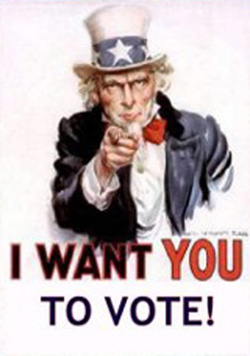
To Vote or not to Vote, that is the question: The answer is VOTE!


On November 6, 2012, U.S. citizens will vote for the next president, as well as some state and local offices. Joining them, will be my father who will cast his first vote for a United States president. Talk about a big day in a 74 year old, Cuban-born, person’s life!  (It isn’t his first time voting, as he has enthusiastically voted in every local election since becoming a citizen in March of 2009.)

It’s exciting to think that someone would care enough to participate in the electoral process after a lifetime of not doing so. It is a great lesson for those who are too_ whatever_ not to vote, to know of someone who is inspired and concerned enough to want to actively participate in a process that often is viewed cynically and without any fanfare. If your RIGHT TO VOTE seems mundane or pointless, you may need to live in a country where people lack that ability and absorb the preciousness of that right.

It is hard to believe that some people will not exercise their right to participate in this important process. The reasons go from unacceptably lame to understandably unacceptable. And yes, I realize that two, or even three, candidates can’t possibly appeal to every person in the country; and as with marriage or most relationships, there is always SOMETHING about the person you just don’t like. But, that isn’t the point. The point is - VOTING is a civic duty and a responsibility that too many people take for granted.

Here’s a little explanation of voting in more academic terms:
In a democracy, a government is chosen by voting in an election: a way for an electorate to elect, i.e. choose, among several candidates for rule. In a representative democracy voting is the method by which the electorate appoints its representatives in its government.


A vote is a formal expression of an individual's choice in voting, for or against some motion (for example, a proposed resolution), for a certain candidate, a selection of candidates, or a political party. A secret ballot has come to be the practice to prevent voters from being intimidated and to protect their political privacy. Voting usually takes place at a polling station; it is voluntary in some countries, compulsory in others, such as Argentina, Australia, Belgium and Brazil.  – Wikipedia

WOW! That last line! In some countries, voting is compulsory? Imagine that! In my humble, or not so humble opinion, those countries have the right idea. In our great nation, we have SO MUCH FREEDOM; we even have the freedom to NOT exercise one of the most important rights we possess. Now that’s something.

I don’t presume to tell anyone how they should vote. That is just as bad as telling someone “who or what” they should pray to, or who they should marry, or how they should live their lives. It defeats the purpose of, wait for it…FREEDOM.  You see where I am going with this. It isn’t that I want to tell anyone how they should vote, because that isn’t for me to say. I respect, even if I disagree with, another person’s choices. I may not understand it, like it, or even think it is a good idea, but it isn’t my job, my place, or my decision to decide for them.

To be 100% honest, I don’t like politics or most politicians. I have my own personal reasons and frankly, it isn’t party-based or even about many of the individuals. I find the whole business very divisive and polarizing. Politics has become MEAN-SPIRITED, cruel, dehumanizing, and theatrical. It makes my head hurt. And in a 24/7 news world, the spin and hype can become overwhelmingly depressing. Most of the coverage isn’t about real issues, it is aboutpersonalities and an endless stream of pundits and talking heads and controversial “radio personalities” who just want higher ratings. It is exhausting. It makes many people really crazy. Seriously, crazy.

 I realize politics is big business. I understand the whole campaign industry and view much of it with cynicism and loathing, BUT I take democracy very seriously, and since the political process, as flawed as it may be, it the vehicle that produces our democracy and precious freedoms (hopefully), I accept and embrace it. Our process isn’t perfect, but it certainly beats many of the alternatives.

This coming Tuesday, my family will be celebrating OUR RIGHT to vote, even more than who wins the election. My father’s exercise of his civic duty, and his belief in the democratic process under the Constitution, is far more important to me than which candidate is chosen by the majority of the American people. I know that may seem hard to believe, but it is true. Presidents come and presidents go. There are always going to be disappointed people after Election Day. That’s how it goes. But the day after the election, we are all still Americans, and democracy will still be alive and well.


So get out there and exercise your right to vote. Many people around the world have, or would have, died to have it.


Sunday, October 7, 2012

October is SIDS, Pregnancy and Infancy Loss Month

 
                                                                            - Original graphic by Anna Sargent

October is Sudden Infant Death Syndrome (SIDS) Awareness Month, a time to educate parents, grandparents, caregivers, and family members about the risk factors associated with SIDS.


On November 23, 2001, my family suffered the devastating loss of my grandson, Brian K. Sargent, to SIDS. He was six weeks old. SIDS Awareness is a personal cause to our family and we hope to be able to comfort other families and to make parents and caregivers aware in hopes of prevention.


Facts about SIDS in the Washington, DC Area:

• Infant mortality rate is 15 deaths per 1,000 live births (twice the national rate of 7.1)
• SIDS rate is also double the national rate (approximately 120 per 100,000 live births each year)

In 2006:• 9 babies died from SIDS in DC
• 90 babies died in Virginia
• 64 babies died in Maryland

Terry Rainey, a resident of the DC Metropolitan area, said this about his experience of losing an infant son to SIDS:

“I lost my son Joe in November of 1996, and every day I feel the pain of that loss. There are no easy answers, just some very tough questions, when one faces such a tragedy. Through the help of family and friends, I have come to appreciate Joe's eight months of life as a gift. Also I greatly value the efforts of the SIDS Alliance in helping thousands of other parents who have lost loved ones. With the strides that have been made in SIDS awareness and research, I am hopeful that we will see the day that no parent will lose a child to SIDS.”

 
What groups are most at risk for SIDS?

Babies who are placed to sleep on their stomachs or sides are at higher risk for SIDS than babies who are placed on their backs to sleep. African-American babies are more than two times as likely to die of SIDS as Caucasian babies. American-Indian/Alaska Native babies are nearly three times as likely to die of SIDS as Caucasian babies.

The preliminary infant mortality rate for 2007 was 6.77 infant deaths per 1,000 live births, a 1.2 percent increase from the 2006 rate of 6.69, though not considered statistically significant. Birth defects were the leading cause of infant death in 2007, followed by disorders related to preterm birth and low birth weight. Sudden infant death syndrome (SIDS) was the third leading cause of infant death in the United States. -Centers for Disease Control and Prevention (CDC)


Sudden Infant Death Syndrome (SIDS) and Sudden Unexpected Infant Death (SUID): Reducing the Risk

Positioning

• Babies should always sleep on their back.
• Place baby on his/her back to sleep at night time and naptime.
• Babies shouldn’t sleep on their side. They may roll to face down position.

Cribs

• Every baby should sleep in his/her own crib.
• Place baby on a firm mattress in a safety approved crib.
• Remove all fluffy and loose bedding from the sleep area. The only thing in the crib should be the baby.
• Make sure baby’s head and face stay uncovered during sleep.
• Use blanket sleepers instead of blankets during colder months.

Room sharing

• Babies from birth to age 6 months should sleep in the same room with their parents.
• Babies should not sleep on the same sleep surface with their parents.
• Bring the baby into your bed for cuddling and feeding, but return the baby to his/her crib when you are ready to go back to sleep.

Other tips

• Temperature in home should be 68-72 degrees Fahrenheit in the winter and 70-85 degrees Fahrenheit in the summer.
• Don’t let baby get too warm during sleep.
• Use pacifiers at naptime and bedtime during the first year, but not during the first month for breast-fed babies. -Children's National Medical Center Washington, DC © 2009

First Candle/SIDS Alliance is a national nonprofit health organization uniting parents, caregivers and researchers nationwide with government, business and community service groups to advance infant health and survival. With help from a national network of member and partner organizations, First Candle is working to increase public participation and support in the fight against infant mortality.

Important Resources for parents and caregivers:

The Sudden Infant Death Syndrome Foundation of Washington

Follow SIDS Resource Center on Twitter

National Healthy Start Association Toolkit Resource Center Web site at the National Center for Education in Maternal and Child Health, Georgetown University © Georgetown University

U.S. Consumer Product Safety Commission

Rise in Infant Suffocations Renews Debate On Bed-Sharing By Rob Stein ©2009 The Washington Post Company

Why is SIDS More Common in African American Populations?

Halo Sleep Sack -The Safer Way to Sleep®

Air Force Veteran Invents SIDS Prevention Device © Copyright 2003-2009 I-Newswire

Hospital will promote SIDS awareness in October © 2009 The-Dispatch.com

Back to Sleep Campaign and the Healthy Child Care America Campaign. © AMERICAN ACADEMY OF PEDIATRICS

*************************************************************

                                                                  Brian K. Sargent
 

Of things unseene how canst thou deeme aright,
Then answered the righteous Artegall ,
Sith thou misdeem'st so much of things in sight?
What though the sea with waves continuall
Doe eate the earth, it is no more at all:
Ne is the earth the lesse, or loseth ought,
For whatsoeuer from one place doth fall,
Is with the tide unto an other brought:
For there is nothing lost, that may be found, if sought.

-The Faerie Queene by Edmund Spenser
Book V Canto II stanza 39

Orignially written and published in 2009 for the Examiner.com site